

























































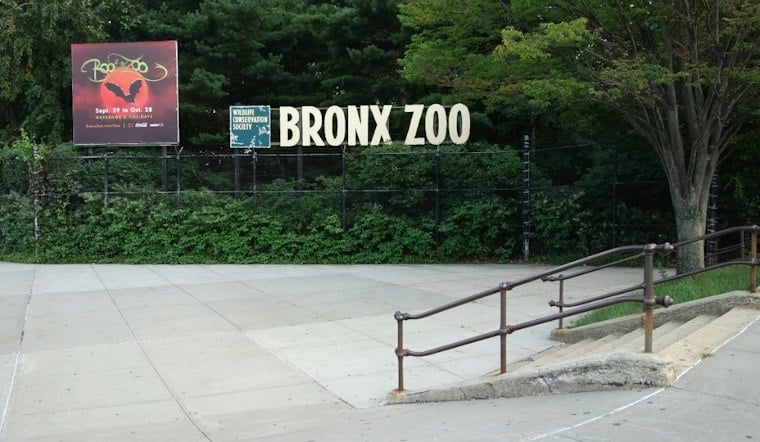
More than a century after a tree-killing fungus was first documented on its grounds, the Bronx Zoo is planting American chestnut trees again. The Wildlife Conservation Society and the New York Restoration Project will hold a ceremonial planting of hybrid American chestnut trees at the zoo on Monday, October 5, marking a symbolic homecoming for a species that once towered over much of the eastern United States before nearly disappearing entirely.
The chestnut blight that doomed those forests was first discovered right there at the Bronx Zoo in 1904, according to The New York Times City Room. Zoo chief forester Hermann Merkel is credited with documenting the blight that year, according to the Wildlife Conservation Society. Within decades the fungus tore through the American chestnut's native range, spreading from Maine to Florida and west to the Ohio Valley, per the zoo's account, and by 1940 nearly four billion American chestnut trees had disappeared as a result, according to Manhattan Times News.
The scale of that loss is hard to overstate. The American chestnut had provided food and habitat for wildlife and timber for generations of people, per the Wildlife Conservation Society, and Manhattan Times News describes it as a keystone species so many others depended on for food, shelter and habitat. Today the tree is considered functionally extinct in the wild, not because the blight kills it outright but because the fungus cannot reach the underground root system even as it destroys everything above ground, according to the New York Restoration Project.
A Hybrid Built to Survive
The trees going into the ground at the Bronx Zoo are hybrids bred specifically for blight resistance, and they're being returned to landscapes where the species once thrived, according to the Wildlife Conservation Society. The New York Restoration Project will gift 25 hybrid American chestnut trees for the planting, with The American Chestnut Foundation serving as a partner in that gift, per the zoo's account. The hybrid variety combines the blight resistance of the Chinese chestnut with the American species, the restoration project has said of its broader breeding work.
That breeding strategy isn't the only tool scientists are using. The American Chestnut Foundation says it is employing complementary scientific strategies of traditional breeding, biotechnology and biocontrol, according to The American Chestnut Foundation, and works with a wide range of partners to establish reintroduction populations across suitable habitat. A study published in Nature Plants evaluated three approaches to introducing blight resistance — hybridizing with the resistant Chinese chestnut, intercrossing surviving American chestnuts, and a transgenic method — and found that while none offers a silver bullet, substantial resistance gains are possible, according to Nature Plants.
Highbridge Park's Head Start
The Bronx Zoo planting builds on years of groundwork already underway in northern Manhattan. The New York Restoration Project and its partners have planted and stewarded more than 200 hybrid American chestnuts in Highbridge Park since 2017, according to the Wildlife Conservation Society, and the park now contains New York City's largest chestnut grove. The restoration project's own accounting puts the figure even higher, saying it has planted more than 300 hybrid American chestnut trees in Highbridge Park with NYC Parks and The American Chestnut Foundation.
NYRP and NYC Parks teamed up in 2017 to plant that grove as an urban trial meant to restore the functionally extinct species to its native range, the restoration project has said. The results so far have been encouraging: the organization reports it has lost only one tree to blight since the initial planting, and that several trees have produced nuts since 2023. Manhattan Times News has described the Highbridge effort as the first large-scale planting of new American chestnut trees in an urban area, and the grove has since become part of what the restoration project calls New York City's first official Chestnut Trail.
Building Toward 1,000 Trees Citywide
The Bronx Zoo event expands what the Wildlife Conservation Society describes as the American chestnut restoration network, and it feeds into a much larger citywide ambition. The New York Restoration Project launched its 1,000 Chestnut Challenge in 2025, aiming to expand restoration and engage New Yorkers in planting and monitoring chestnut trees across all five boroughs. The group has said its ultimate goal is establishing 1,000 thriving American chestnut trees throughout the city's urban tree canopy, and it plans to collect seeds from the Highbridge chestnuts to plant and monitor saplings citywide as part of that community science experiment.
New York Restoration Project leads what the Wildlife Conservation Society calls the largest urban effort to help restore the American chestnut, working with partners to bring hybrid trees back into the city's landscape. The nonprofit, founded in 1995 by Bette Midler, describes itself as an environmental justice organization and citywide nature conservancy dedicated to expanding access to nature for all New Yorkers. Beyond its chestnut work, the group says it has built or renovated more than 350 gardens, restored more than 300 acres of parkland, and planted and distributed nearly 300,000 trees.
Elsewhere in the city, similar efforts have taken root over the years. In 2011, blight-resistant chestnut seeds were intended for planting in Prospect Park and the Native Flora Garden at the Brooklyn Botanic Garden, according to The New York Times City Room, a borough where more than 1,400 chestnuts had been felled by blight in the first decade of the 20th century alone. Purebred American chestnuts planted in Prospect Park in 2004 later included a survivor that grew to 35 feet tall, the same report noted, while Manhattan Times News reported plans for 20 more American chestnut trees to go into Highbridge Park that spring.
Scientists Say Progress Will Be Gradual
Researchers outside New York are also racing to speed up the science behind blight resistance. Virginia Tech researchers have used genome sequencing and field-trial data to predict blight resistance in young American chestnut trees before they reach maturity, according to Virginia Tech News, with the next generation of genome-selected trees expected to carry twice the average blight resistance of the current population while retaining an average of 75 percent American chestnut ancestry. Those trees are expected to begin producing large quantities of seed for forest restoration within the next decade, per the same report.
Still, scientists caution against expecting a quick fix. Researchers have warned that restoration will take time because disease resistance involves multiple genes and must be strengthened across generations, according to Clemson News. For a species that vanished from nearly its entire range within a few decades, the return now underway in the Bronx and beyond is measured in trees planted one at a time — a slow rebuild of something the blight tore down almost overnight.





